
Justin Holgate
Thompson Rivers University: Open Learning
JOUR 2061: Intro to Multimedia
Professor Daniel Spring
August 4, 2025
AI Voice Cloning Gains Traction Amid Growing Ethical Concerns
Since its introduction to the broader public in late 2022, major advances have been made in the sector of Artificial Intelligence (colloquially referred to as AI). While many have praised its applications in learning, translation, and research, there is growing unease over one of the fastest-growing – and most controversial – developments in AI; voice cloning. The convenience is astonishing – as of 2024, within a few short moments, one is able to convincingly mimic any person’s voice (Weitzman, 2025) using tools such as ElevenLabs. The nature of these tools, being digital, means this issue has effects not just on one region but potentially anywhere across the globe with an internet connection. On one hand, this tech has legitimate uses, such as audiobooks or films, but on the other hand there are significant ethical considerations for such a powerful tool.

Caption: A Woman Picks Up A Call, Seemingly Concerned, Showing The Ease Of Manipulating People Using Voice AI. Taken by Justin Holgate, September 2, 2025
Some proponents of voice AI have argued that these advancements are improvements in communication and creativity. “This funding moves us closer to a world where digital interactions happen by voice—fluid, natural, and as effortless as a conversation,” said Mati Staniszewski, CEO of ElevenLabs (Reuters, 2025).

Caption: A Woman Speaks In Another Language, Showing the Dual Natured Benefits and Downsides of Voice AI. Taken by Justin Holgate, September 2,2025
It is notable that not only are these tools readily available online, but they are also often free, essentially reducing the only barrier to accessing them to an internet connection. Thus, privacy advocates have raised serious concerns about the ethicality due to this ease of access.
Deepfakes and Deception
While some defend these developments as tools for creative purposes, there have been cases of scammers using them to exploit unwitting victims.
Perry Carpenter, a cybersecurity reporter covering AI voice scams, wrote, “…While many are familiar with its use in entertainment and disinformation, the application of voice cloning in targeted cyberattacks, fraud and extortion schemes poses a growing concern for organizations worldwide.” (Carpenter, 2024)
For example, an Arizona mother picked up a call from what sounded to be her daughter in early 2023. The person on the other end of the phone, seemingly her daughter, claimed she had been kidnapped and attempted to extract money from the victim in what turned out to be an AI voice scam (Stefano, 2024). Shortly thereafter, both the FBI and FTC put out warnings in regards to these scams.
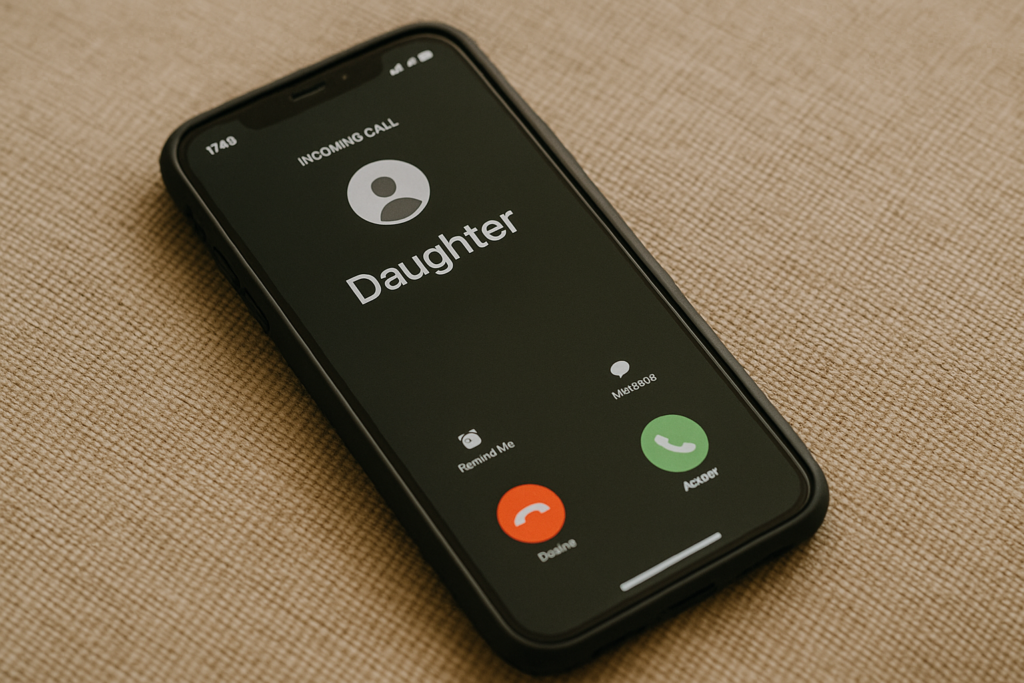
Caption: A Phone Rings With Your Daughter’s Name, demonstrating the scary dissonance between reality and deception. Taken by Justin Holgate, September 1, 2025.
Legal and Ethical Gray Areas
Currently, there is limited legislation in place to address this issue and they vary by jurisdiction. Notably, in the US and Canada, there are no examples of comprehensive laws combating the unconsensual replication of voice.
Experts have pointed out that there’s a gap between what’s possible and what’s permissible, urging for updated legislation, while organizations like Creative Commons and EFF are pushing for clearer consent models and rights over one’s voice.

Caption: A Man Is Displayed With His Face Unseen, Demonstrating the Nefarious Intent of the People Behind The Scams. Taken by Justin Holgate, September 2, 2025
The Bottom Line
Experts recommend that consumers verify any suspicious calls and advocate for stronger digital rights. They point out that if regulators don’t step in to address this problem, then the lines between reality and deception will only increasingly blur.
Some are in favour of it, some are against it, but one thing is for sure – AI voice cloning isn’t going away. If anything, it’s becoming more common—and more convincing. As public awareness grows, so too does the demand for transparency and consent.
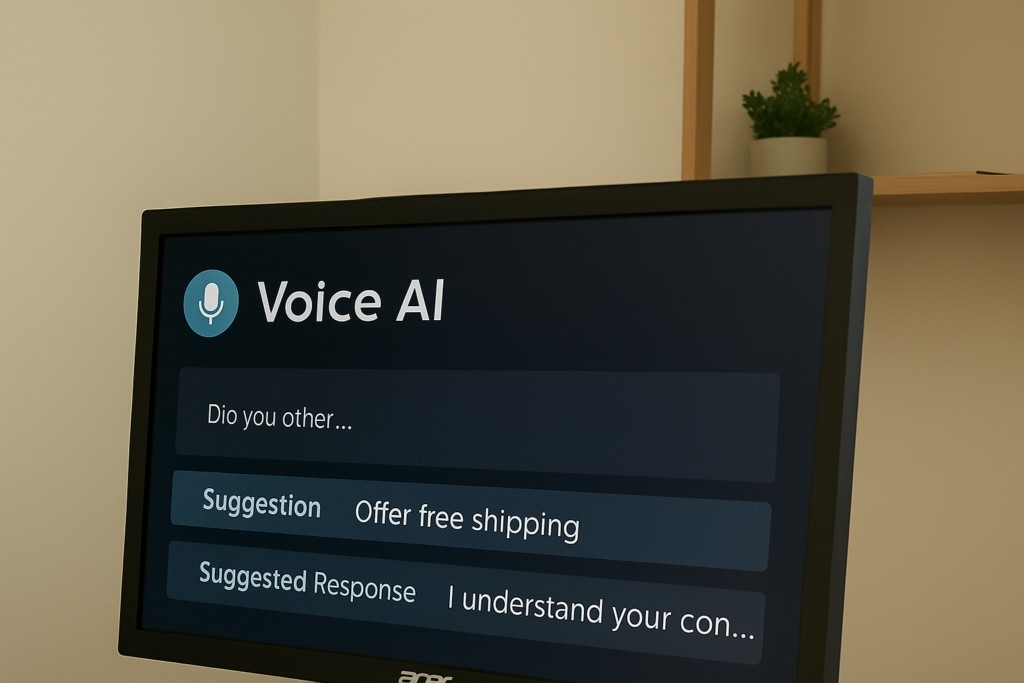
Caption: Voice AI shows suggestions in real time to call center agents, showing an application of it. Taken by Justin Holgate, September 2, 2025
Research Table/Sources
| Element | Details | APA 7th Citation |
| Who | Tech companies (e.g., ElevenLabs, Meta), content creators, scammers, law enforcement, and the public | Reuters. (2025, January 30). Voice AI startup ElevenLabs closes new funding round at $3.3 billion valuation. Reuters. https://www.reuters.com/technology/artificial-intelligence/voice-ai-startup-elevenlabs-closes-new-funding-round-33-billion-valuation-2025-01-30/ |
| What | The rise of artificial intelligence (AI) voice cloning technologies and their applications in entertainment, education, fraud, and accessibility | Carpenter, P. (2024, September 9). AI voice cloning is giving rise to extortion & vishing scams. Corporate Compliance Insights. https://www.corporatecomplianceinsights.com/ai-voice-cloning-extortion-vishing-scams/ |
| Where | Primarily in North America and Europe, but growing globally due to widespread access to AI tools online | |
| When | Gaining traction since late 2022, reaching widespread use by 2024–2025 | |
| Why | Used for accessibility, content creation, dubbing, fraud, and entertainment; raises ethical and legal questions about consent and identity | DeStefano, J. (2023, April 13). Mom warns of hoax using AI to clone daughter’s voice. Good Morning America. https://www.goodmorningamerica.com/family/story/mom-warns-hoax-ai-clone-daughters-voice-98551351 |
| How | Through machine learning models trained on voice samples; many tools require only a few seconds of audio to replicate a voice | Weitzman, C. (2025, January 25). How does voice AI work? Speechify. https://speechify.com/blog/how-voice-ai-work/ |